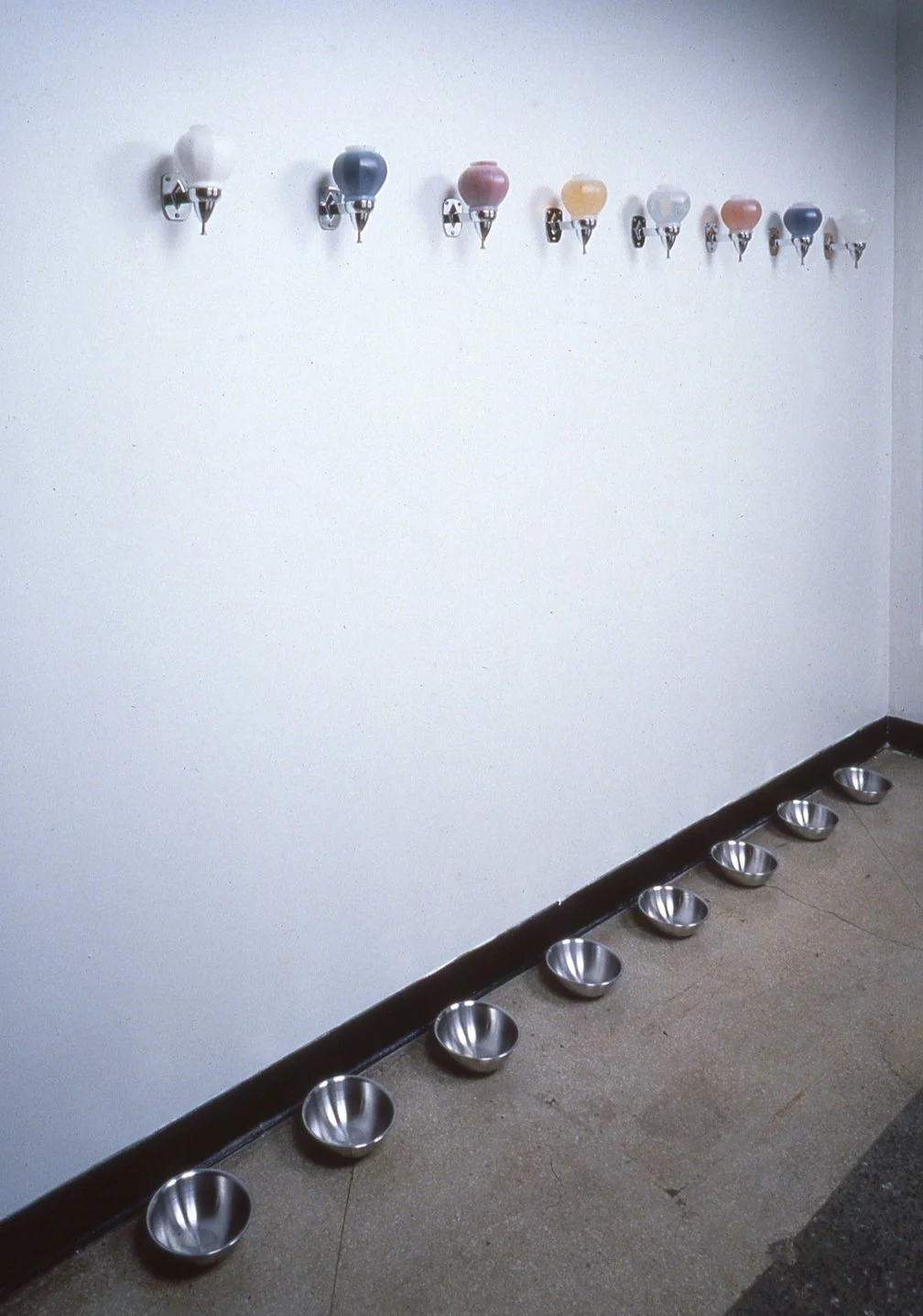
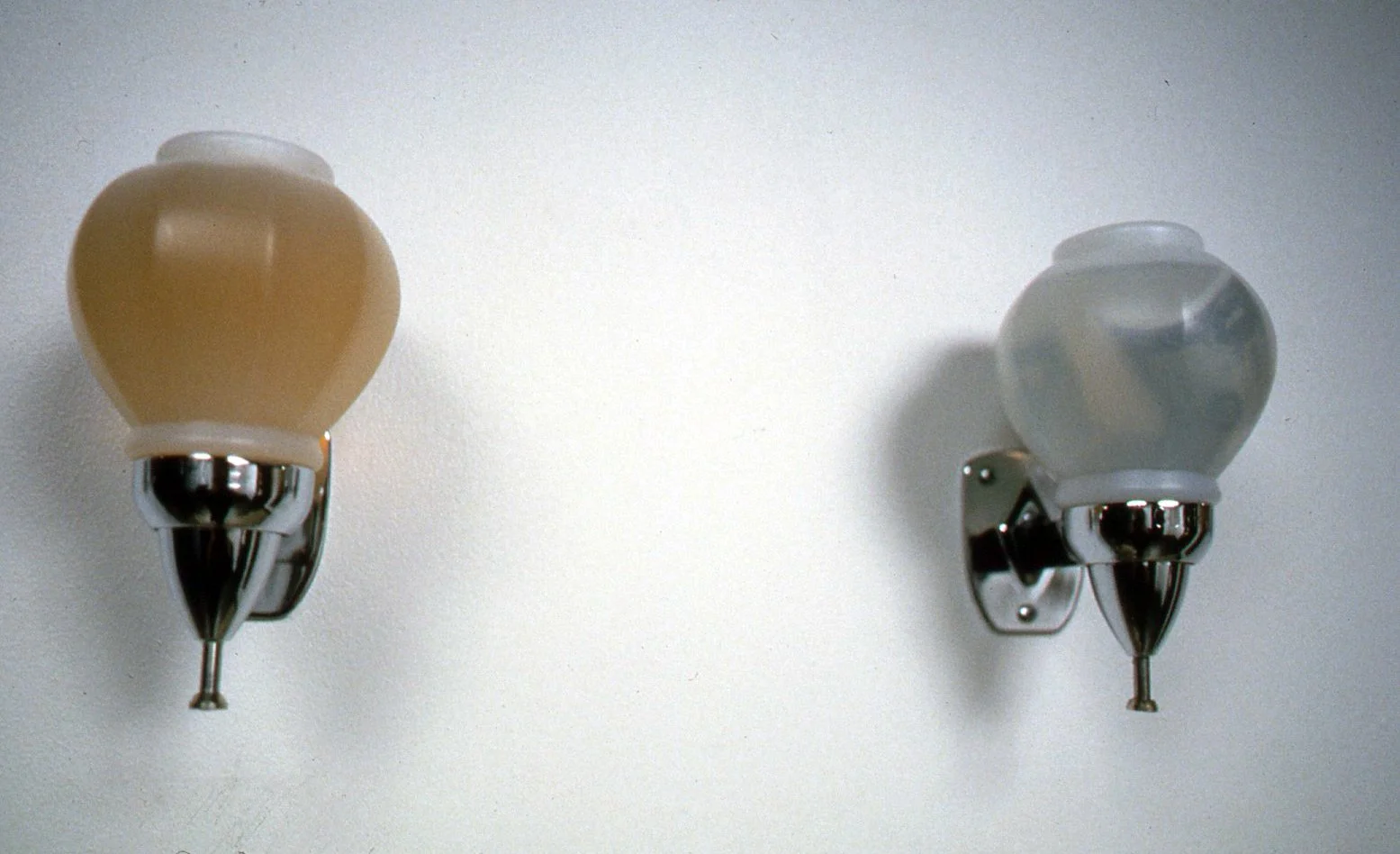
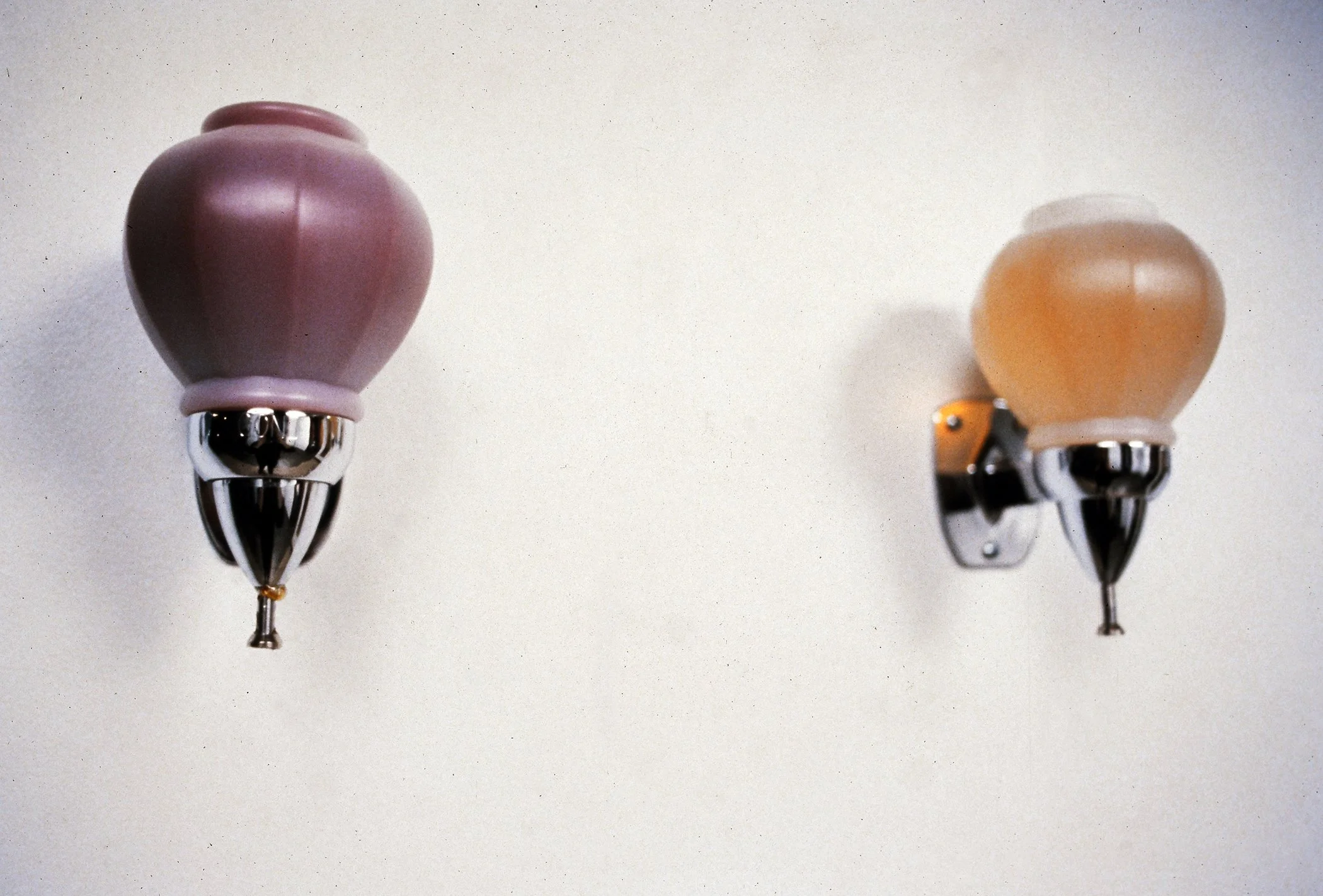
Dispenser, 1991, engraved soap dispensers, stainless steel bowls, honey, wine, glue, laxative, coffee, night time cold medicine, currency, vinegar, ketchup, 16 elements, size variable.
“Dispenser comprises eight wall-mounted bathroom soap dispensers, the type one encounters in public restrooms. Each dispenser was filled with a different liquid creating a spectrum of sinister color lining the wall. On the floor below each dispenser was a stainless steel bowl to collect drippings. Mimicking the trademarks normally stamped across these objects, Brooks subtly inscribed abbreviations that offer clues to the dispensers' contents. "ADHE" almost goes unnoticed on the metal band of a dispenser filled with a white substance. It is not readily apparent what the abbreviation stands for. One must go down the wall of dispensers comparing substances with texts to gain insight into the code. Finally one spotted a dollar bill in a dispenser labeled "CURR," for currency, and the majority of substances become clear-"STIM"/stimulant = coffee. In other hands these dispensers might have been filled with ominous fluids meant to shock or provoke ruminations on one's tenuous physical reality. But Brooks replaces the potential for high-handed social critique with self-parody by using such inane materials.”
Adam Brooks, Abel Joseph Gallery, John Brunetti, New Art Examiner, April 1991
“Dispenser features eight mass-produced soap dispensers, each filled with a different liquid, ranging across one wall of the gallery. On the floor below each one rests a stainless steel bowl ready to catch inadvertent drips. Subtly engraved on each dispenser is part of a word—a clue to help identify the type of liquid inside. The letters are difficult to see because they are small and thinly etched. To make matters more difficult, the words they stand for are only general categories for the specific substances in the dispensers. Some word-clue substance combinations are more accessible than others. With a little work we might guess that "ADHE" indicates adhesive, and that the white liquid in this dispenser in glue. But other combinations are more obscure. "CATH," which I found refers to catharsis, could just as easily point to catholic or catheter. Figuring out that the liquid in this container is a laxative requires a substantial mental leap. Despite such ambiguities, Dispenser establishes a strong physical relationship to our own bodies through its hand-washing theme. This, coupled with the objects' rigid public-restroom installation, makes the experience of the piece an engaging, almost familiar one.”
The Blasted Word: Adam Brooks: Abel Joseph Gallery, Lynda Barckert, Chicago Reader, 1 February, 1991.
“As if transported to a land where the dominant language is "foreign," the viewer was forced to guess at the meaning of the most mundane bits of phraseology. Liquid-soap dispensers arranged in a line were filled with a variety of substances, each identified by a four-letter code. A floating dollar bill gave us the clue to "CURR," and it was not difficult to make sense of the thick white glue of “ADHE” or the flat beer of "INEB," but the significance of "AMBR," "DEPR" and "CATH" remained more pointedly elusive.”
Adam Brooks, Abel Joseph Gallery, Michael F. Bulka, Art in America, June 1991