GLASSWARE SETS
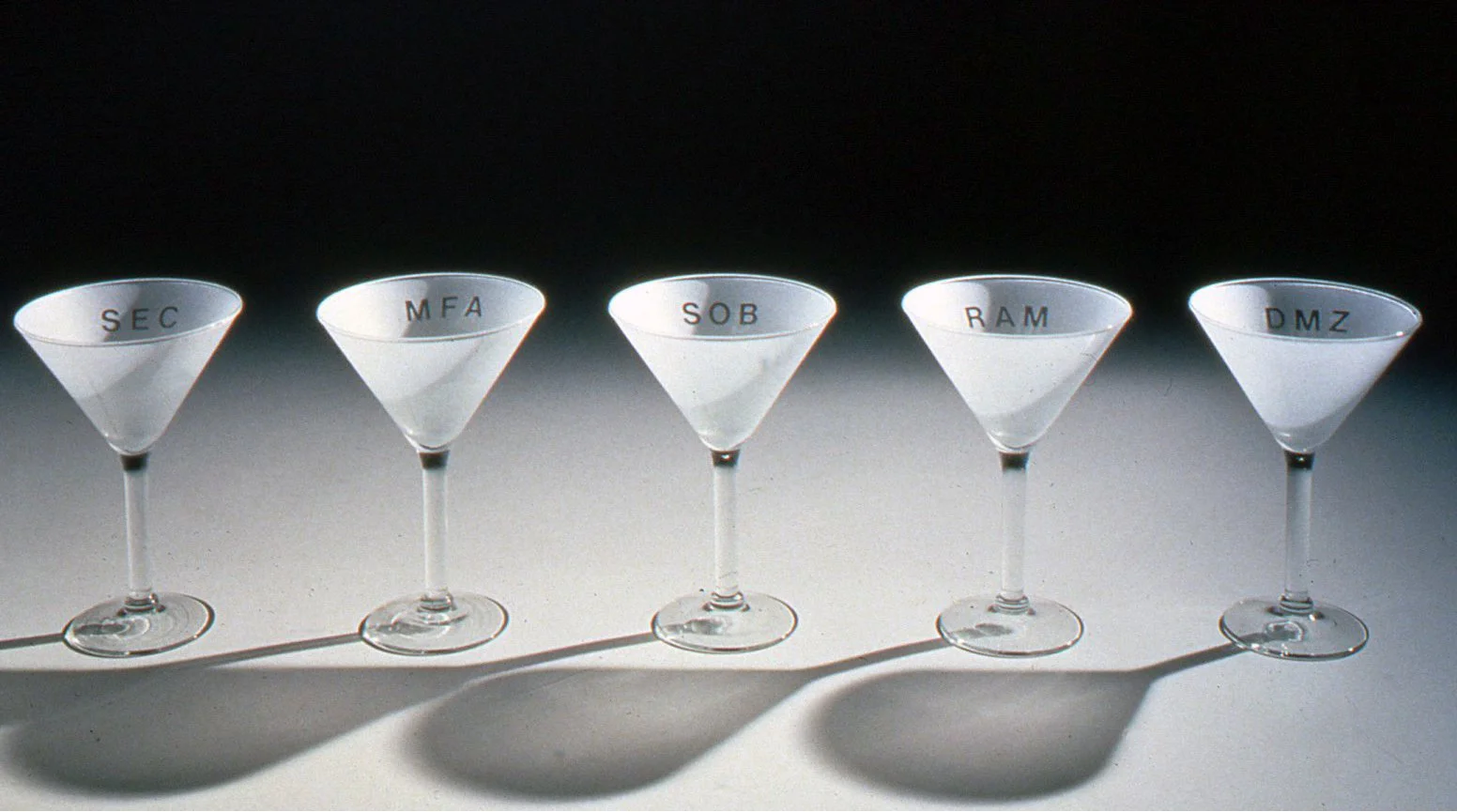
Acronym Set (detail), 1991, sandblasted glassware, set of 8, edition of 10, each 7” x 4” x 4”.
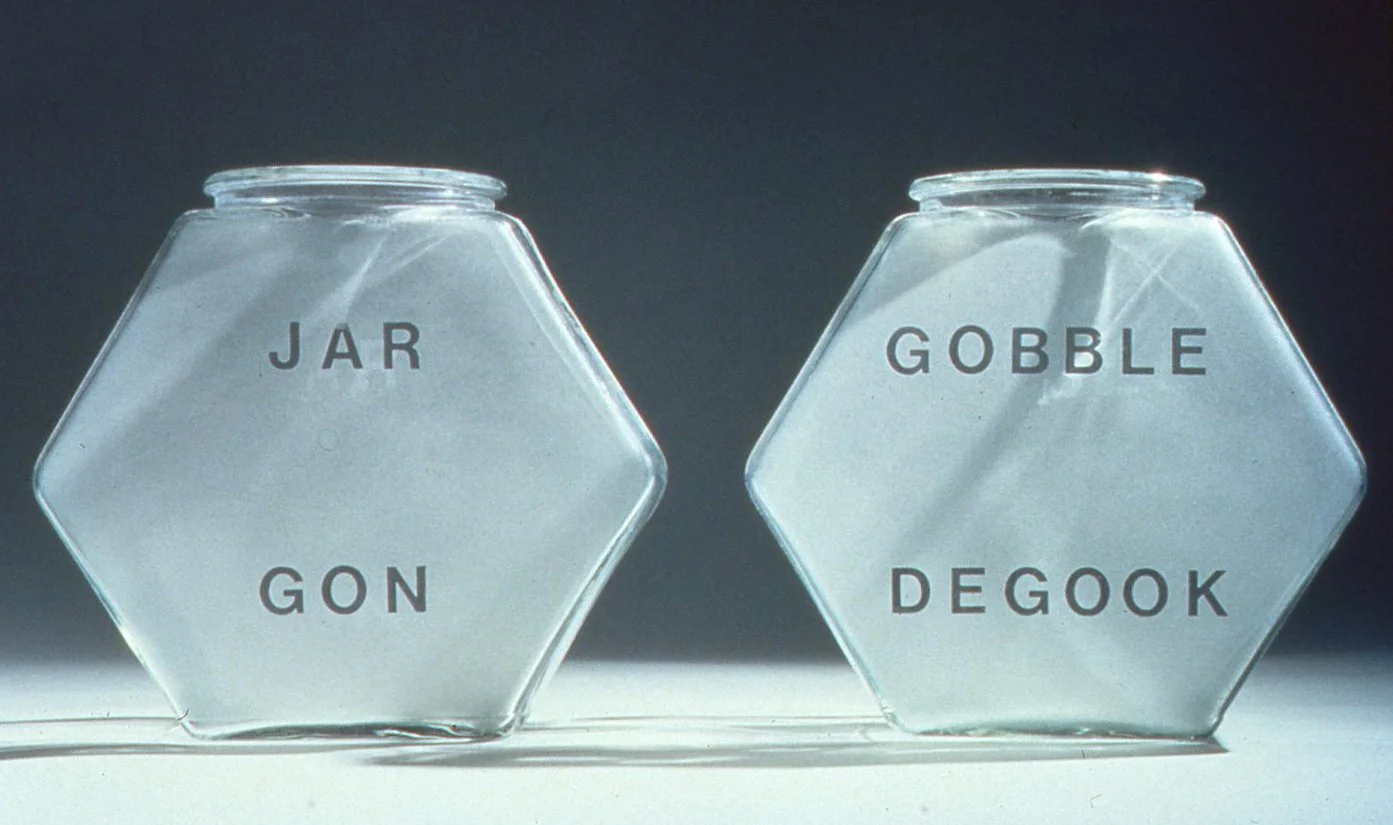
Slang Set (detail), 1991, sandblasted glassware, set of 4, edition of 10, each 9” x 5” x 10”.
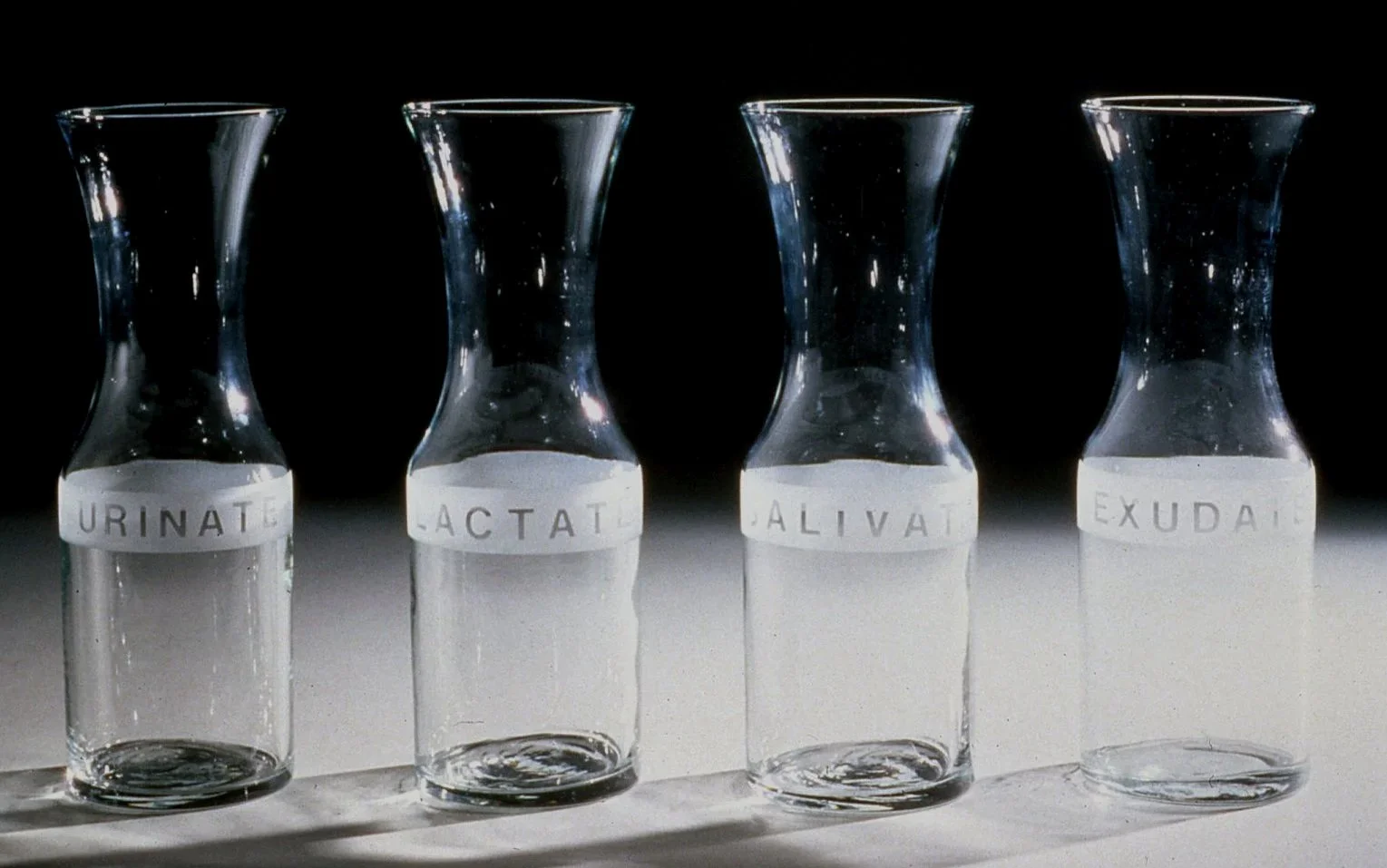
Excrete Set (detail), 1991, sandblasted glassware, set of 7, edition of 10, each 9” x 6” x 6”.
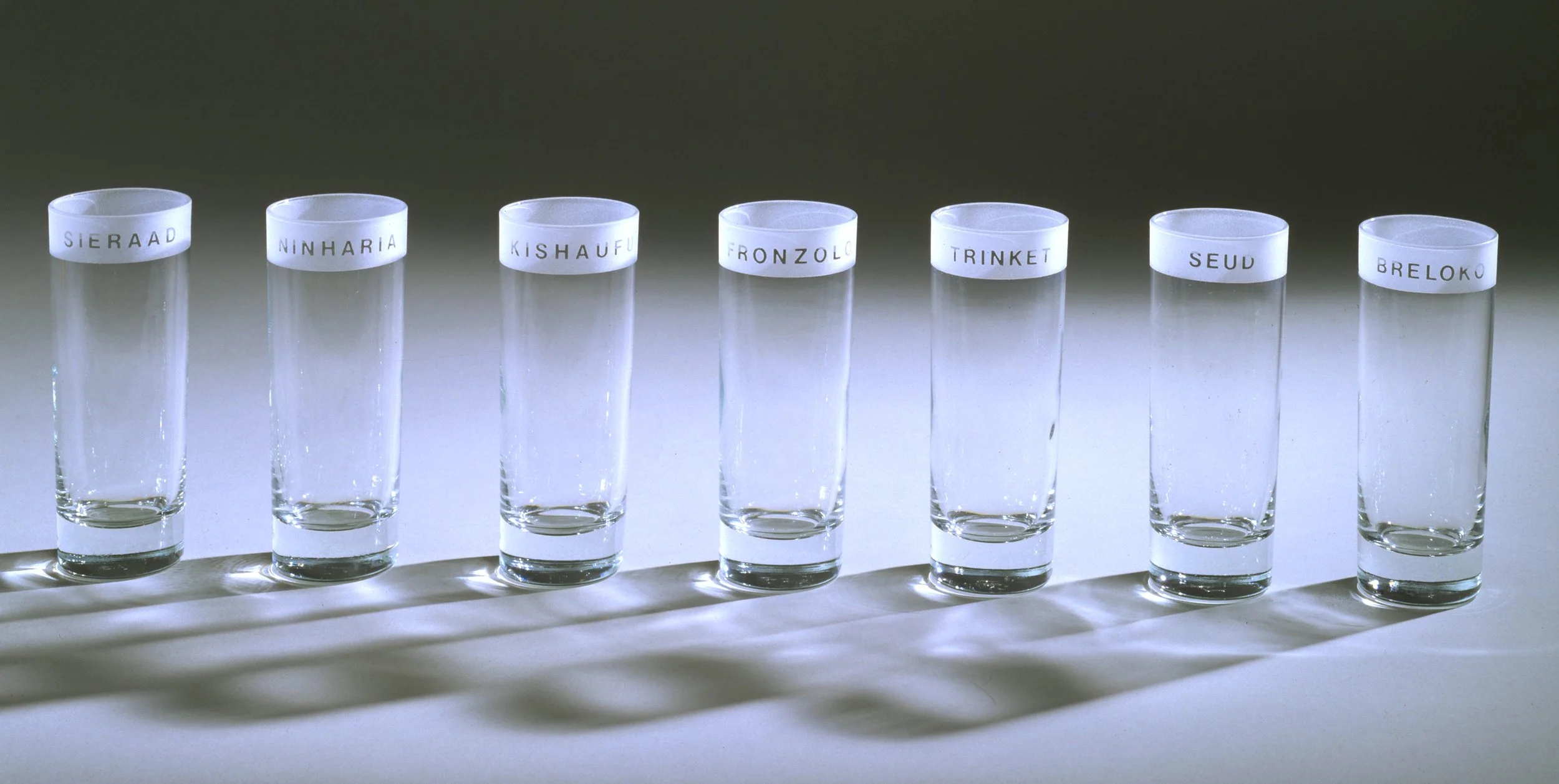
Trinket Set (detail), 1991, sandblasted glassware, set of 10, edition of 10, each 6” x 3” x 3”.
“(In other pieces) Brooks combines words with three-dimensional, body-referencing objects like cocktail glasses, soup ladles, and hand-soap dispensers. Because they link intangible linguistic meaning with concrete human physicality, these works are the most satisfying in the show. In a display window facing the street, several shelves holding glass objects have been arranged in Crate & Barrel fashion, each shelf containing multiples of a single glass item. There is a shelf of martini glasses, a shelf of wine carafes, and so on. The repetition of transparency and form produces a symmetry that seduces and flatters the viewer/buyer. These attractive "goods" are meant to beautify our dinner tables, impress our friends, and help quench our various appetites. But the artist makes us pay for this visual flattery through the provocative words sandblasted onto the surface of the objects. Most powerful is the group of carafes, called Secrete Set. We usually identify a carafe's primary function as dispensing wine or another beverage, but these carafes are labeled with words like "urinate," "defecate," "ejaculate," and "menstruate." Because bodily secretions are often tested for harmful "cultures," here the carafes seem transformed into specimen jars. The artist makes the connection between physical and cultural disease with impressive simplicity.”
Excerpt from a review of the 1991 exhibition at Abel Joseph Gallery, Chicago, by Lynda Barckert, Chicago Reader, 1 February, 1991.
“Adam Brooks's employ of glass in his art has been manifested most systematically in his sandblasting work on sets of vessels, glasses, and the like. Brooks obtains his various bottles, carafes, martini glasses, drinking glasses, cookie jars, mirrors, specimen jars, soap dispensers, shot glasses, canisters, highball glasses, etc., from restaurant supply stores or catering outlets--the idea of fabricating glass is of no particular interest to Brooks; rather, the very functionality of his source material, its existence as the unseen accoutrements that companion our daily lives, their simple but often lovely prosaic design appearances gives them a kind of neutral or utilitarian quality he admires. These vessels became his signage, blank vitrines he amends with directed bits of text. Acronym Set II (1991) is a group of handsome martini glasses etched with three-letter acronyms such as MFA, DMZ, BYO, SOB, ICU, SEC, etc. That the last three of these can present alternative readings is a little bonus for Brooks, the kind of verbal play and text multiplier he favors. He regularly heightens our attention to the point that we start to become wary of words, and begin to see cracks in what had previously seemed the secure and clear structure of language. Slang Set (1991) is similarly seditious and double- or quadruple-edged; here Brooks sandblasts a word split in half on the side of large hexagonal vessels that have the appearance of cookie jars. JAR/GON and GOBBLE/DEGOOK are two words, almost four words, that have their own meaning, but split asunder here end up alluding to (in order) the vessel itself, its emptiness, its function as a site of food, and to the residue that might be at its bottom. Bodily discharges as a subject for art? In Excrete Set (1991) Brooks took seven carafes, the kind that would hold water or the house wine at a restaurant table, and sandblasted one word onto each drawn from our seven bodily excretions--defecate, ejaculate, exudate, lactate, menstruate, salivate, and urinate. Trinket Set (1991) is twelve water glasses whose rims are tastefully blasted with the word "trinket" as translated into languages such as Swahili, Gaelic, Esperanto, Portuguese, Italian, etc.
Excerpt from Adam Brooks: Only Words by James Yood, 'Glass' magazine, Spring 1995.